


Behind every successful complex dental outcome is a planning process most patients never see – one that determines whether the result lasts five years or a lifetime.
When a patient presents with a single cavity, the treatment plan is straightforward: clean out the decay, place a filling, polish, done. But what happens when the problems are not simple? What happens when a patient has worn-down teeth, a shifting bite, gum disease, missing teeth, failing old dental work, and a jaw joint that clicks and aches – all at the same time?
This is the reality of complex dental treatment planning. It is far more common than people think. Years of gradual deterioration, deferred treatment, and piecemeal dental work accumulate until a patient reaches a point where the individual problems cannot be separated from each other. You cannot crown a tooth until the gum disease is treated. You cannot place an implant until the bite is corrected. You cannot correct the bite until you know which teeth you are keeping.
These are not cases that a single clinician can manage alone, no matter how experienced. They require a team of specialists, working from a unified plan, executing each phase in a carefully orchestrated sequence. At Smile Solutions, complex dental treatment planning is a core part of what we do – and the process behind it is what separates truly excellent outcomes from results that compromise, deteriorate, or fail.
What Makes a Dental Case “Complex”?
Not every case involving multiple procedures is complex. A patient who needs a few fillings and a clean has multiple procedures but a straightforward plan. Complexity in dental treatment planning arises when:
Multiple dental disciplines are involved. The case requires input from two or more specialist fields – periodontics, endodontics, orthodontics, prosthodontics, oral surgery, or others.
The problems are interdependent. You cannot solve one problem without first addressing (or at least accounting for) another. The treatment sequence matters enormously.
The bite (occlusion) needs to be changed. Altering how the upper and lower teeth come together affects every restoration in the mouth. Getting the new bite position right requires careful analysis before any teeth are prepared.
There are structural deficiencies. Insufficient bone for implants, inadequate tooth structure for crowns, or compromised gum tissue that needs rebuilding before definitive restorations can be placed.
The patient has medical complications. Conditions such as diabetes, bleeding disorders, bisphosphonate therapy, immunosuppression, or a history of head and neck radiation all affect treatment planning and sequencing.
Previous treatment has failed. Failed root canals, failing implants, broken crowns, or poorly fitting dentures that need to be reassessed and replaced add layers of complexity.
The Planning Process: How Specialists Collaborate
At Smile Solutions, when a complex case is identified – whether during a routine check-up or when a patient specifically seeks comprehensive care – a structured planning process begins.
Here is what that looks like in practice.
Step 1: Comprehensive Diagnostic Assessment
The first step is gathering complete information. This goes well beyond a standard dental examination:
- Clinical examination. Every tooth is assessed individually – its structural integrity, the condition of any existing restorations, the health of the nerve (pulp vitality testing), the periodontal status (probing depths, bleeding, mobility, recession), and its strategic importance in the overall plan.
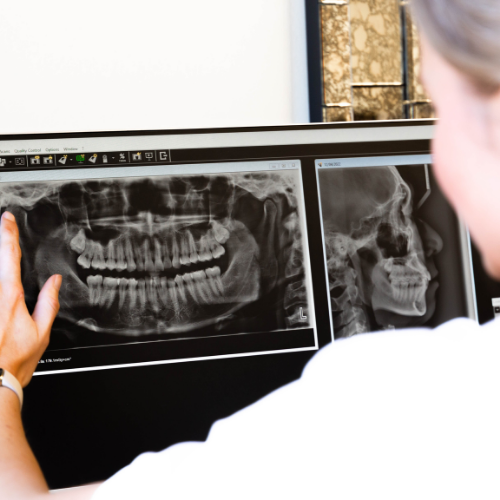
- Radiographic assessment. A full-mouth series of periapical radiographs, a panoramic radiograph (OPG), and in many cases, a cone beam CT scan (CBCT) provide detailed views of root anatomy, bone levels, sinus proximity, nerve positions, and the extent of any pathology.
- Photographs. Clinical photographs of every tooth, the gum line, and the bite from multiple angles create a permanent record and allow specialists to review the case without the patient needing to be present.
- Study models or digital scans. Impressions or intraoral digital scans capture the exact shape and position of every tooth, allowing the specialists to analyse the bite on mounted models or in digital planning software.
- Facebow recording. A facebow records the spatial relationship between the patient’s upper jaw and their skull, allowing study models to be mounted on an articulator (a device that simulates jaw movement) in the exact position they occupy in the patient’s head. This is essential for cases where the bite height or jaw relationship will be changed.
- Bite analysis. Recording how the teeth come together in various jaw positions – not just “biting down” but also sliding left, right, and forward – reveals how the current bite functions and where problems exist.
- TMJ assessment. Evaluating the jaw joints for clicks, pops, pain, or limited opening. Any TMJ issues must be addressed or stabilised before irreversible dental treatment begins.
Step 2: Problem List and Prioritisation
With complete diagnostic records in hand, the lead clinician (typically a prosthodontist for restorative-focused cases) develops a comprehensive problem list. This catalogues every issue identified:
- Teeth with active decay
- Teeth with failing restorations
- Teeth requiring root canal treatment or retreatment
- Teeth with periodontal compromise (gum disease, bone loss)
- Missing teeth and their replacement options
- Occlusal (bite) problems
- Aesthetic concerns
- TMJ issues
- Soft tissue deficiencies (gum recession, inadequate keratinised tissue)
- Bone deficiencies (for implant sites)
Each problem is then prioritised and categorised by which specialist discipline needs to address it.
Step 3: Case Conference
This is where the multidisciplinary model at Smile Solutions makes a tangible difference. The relevant specialists review the case together – in person, in the same building, looking at the same records on the same screens.
A typical case conference for a complex restorative case might involve:
- The prosthodontist presenting the case and outlining their vision for the final result
- The periodontist commenting on which teeth have viable periodontal support and which are hopeless, and what preparatory gum treatment or grafting is needed
- The endodontist assessing which teeth need root canal treatment or retreatment and their prognosis
- The oral surgeon discussing implant feasibility, bone grafting requirements, and surgical sequencing
- The orthodontist advising on whether tooth movement could improve the conditions for restoration or implant placement
The discussion is iterative. The prosthodontist might propose keeping a particular tooth, but the periodontist may advise that its long-term prognosis is poor. The oral surgeon might suggest that implant placement in one area would be more predictable if the orthodontist first uprighted an adjacent tilted molar. Each specialist’s input refines the plan.
The output is a unified, sequenced treatment plan that every team member understands and has contributed to. This is fundamentally different from a general dentist making a plan alone and then referring out individual components to separate specialists who have no knowledge of the broader strategy.
Step 4: Treatment Plan Presentation
Once the specialist team has agreed on a plan, it is presented to the patient in clear, understandable terms. This presentation typically covers:
- The current situation – what has been found and why it matters
- The proposed treatment – each phase, what it involves, who will perform it, and why it is sequenced in that order
- Alternatives – including the option of doing nothing and what the consequences would be
- Timeline – complex cases may span 12 to 24 months from start to finish
- Costs – itemised by phase, with health fund estimates where applicable
- Payment options – including staged payments aligned with treatment phases
At Smile Solutions, we believe patients should never feel rushed into a decision about complex treatment. The treatment plan is documented in writing, and patients are encouraged to take it home, consider it, discuss it with their family, and return with questions.
Step 5: Sequential Treatment Execution
Complex treatment plans are executed in a specific sequence. While every case is different, a common order of phases is:
- Phase 1: Emergency and urgent treatment. Address any active pain, infection, or functional problems that need immediate attention.
- Phase 2: Disease control. Treat active dental disease – periodontal treatment (deep cleaning, gum surgery), removal of hopeless teeth, management of active decay. The goal is to stabilise the mouth and create a healthy foundation.
- Phase 3: Orthodontic treatment (if indicated). If teeth need to be repositioned before restorative work can proceed – for example, uprighting a tilted molar to make space for an implant, or aligning crowded teeth before veneers – this happens now.
- Phase 4: Surgical procedures. Implant placement, bone grafting, sinus lifts, and soft tissue grafting are performed once the mouth is disease-free and teeth are in optimal positions.
- Phase 5: Healing and integration. Time is allowed for implants to integrate with bone (typically three to six months) and for grafted tissue to mature.
- Phase 6: Provisional restorations. Temporary crowns, bridges, or veneers are placed to “test drive” the new bite position, aesthetics, and function. This is a critical phase – it allows both the patient and the clinicians to evaluate the plan before committing to permanent restorations.
- Phase 7: Definitive restorations. Once the provisional restorations have been validated – and adjusted as needed – the final, permanent restorations are fabricated and placed. At Smile Solutions, these are crafted by our in-house Smile Lab, where the ceramist and prosthodontist can collaborate directly.
- Phase 8: Maintenance. A tailored maintenance schedule is established, typically involving more frequent check-ups and cleans than a standard patient, to protect the investment in the completed treatment.
Why Single-Practitioner Practices Struggle with Complex Cases
It is not a criticism of solo practitioners to observe that complex, multi-specialist cases are difficult to manage in a single-practitioner setting. The challenges are structural:
- Limited scope. A general dentist performing their own root canals, placing their own implants, and managing their own gum treatment is working across multiple disciplines without the depth of training that each specialist brings. The root canal may not be as thorough as one performed by an endodontist with a microscope. The implant may not be positioned as precisely as one placed by an oral surgeon working from a prosthetically driven plan.
- Fragmented communication. When a solo practitioner refers out to external specialists, coordination becomes a chain of letters and phone calls rather than a corridor conversation. Information is lost or delayed. Adjustments to the plan are harder to make.
- Sequencing errors. Without a unified plan developed by all the involved specialists together, treatment phases may be performed in a suboptimal order. An implant placed before orthodontic alignment might end up in a position that compromises the final restoration. A crown made before a bite discrepancy is corrected might need to be redone.
- No provisional testing. The provisional restoration phase – where the new bite and aesthetics are tested before permanent restorations are fabricated – is sometimes skipped in less comprehensive practices, leading to permanent restorations that do not function optimally or that the patient is unhappy with.
A Walk Through a Real Case Scenario
To bring this to life, consider this representative scenario:
The patient: A 52-year-old woman presents with the following: – Upper front teeth are worn, chipped, and discoloured – Two upper back teeth are missing (extracted years ago) – A lower molar has a failing root canal with a recurrent infection – Moderate gum disease with bone loss around several teeth – The bite has deepened over the years as the back teeth have worn – She grinds her teeth at night
The challenge: Every problem is connected. The missing back teeth caused the front teeth to take on more biting force, accelerating wear. The deepening bite is related to the posterior tooth loss and wear. The grinding contributes to everything. You cannot just veneer the front teeth without addressing the missing back teeth and the altered bite, or the veneers will fail.
The team plan:
1. Periodontist treats the gum disease across the mouth (two to three visits)
2. Endodontist retreats the failing root canal on the lower molar
3. Oral surgeon places two implants in the upper arch where the missing molars were
4. During the healing period, the prosthodontist places provisional restorations to establish a corrected bite height and test the new tooth positions
5. After implant integration, the prosthodontist delivers the definitive restorations – porcelain crowns on the implants, veneers or crowns on the worn front teeth, and a crown on the retreated molar
6. A night guard is fabricated to protect the new restorations from grinding
7. Maintenance schedule established: three-monthly hygiene visits for the first two years
Total treatment time: Approximately 14 months from first specialist appointment to completion.
The outcome: The patient has a restored bite at the correct height, full posterior support to protect the front teeth, resolved infection, healthy gums, and a smile she is genuinely happy with. Because the plan was developed collaboratively by specialists who each understood their role in the whole, every component supports every other component.
The Smile Solutions Difference
With over 80 clinicians, more than 25 registered dental specialists, 44 dental chairs, an in-house dental laboratory, and the full spectrum of sedation options, Smile Solutions in Melbourne’s CBD is purpose-built for complex dental care. Our model is not an accident – it was designed from the ground up by our founding principal, Dr Kia Pajouhesh, to enable exactly the kind of collaborative, multidisciplinary treatment planning that complex cases demand.
Not every patient needs this level of care. Many of our patients come in for routine check-ups and leave 30 minutes later. But when a case is genuinely complex, when the problems are interconnected and the stakes are high, having every specialist you might need under one roof is not a convenience. It is a clinical necessity.
Facing a complex dental situation?
Book a comprehensive assessment at Smile Solutions. Our specialist team will develop a plan that sees the whole picture.