


Smile Solutions - Melbourne CBD

specialist care

Oral & Maxillofacial Surgeons

When it comes to complex oral surgical needs we choose to provide you with optimal care from a registered specialist Oral & Maxillofacial Surgeons
Smile Solutions Dentist Melbourne

What is the role of an Oral & Maxillofacial Surgeon?

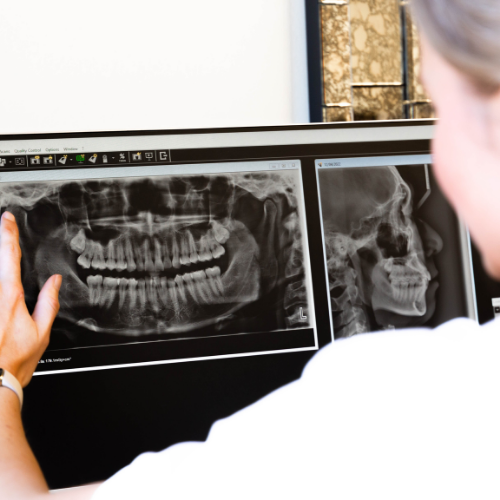
Oral & Maxillofacial surgery is a highly specialised field of dentistry that involves the diagnosis, surgical treatment, and management of diseases, injuries, and defects affecting the mouth, gums, teeth, and jaws, including their function and appearance. This includes implant dentistry, bone grafting, orthognathic (jaw) surgery, and complex wisdom teeth management.

Oral & maxillofacial surgeons are specifically trained to manage these conditions, combining dental, medical, and surgical knowledge and expertise.

Oral & Maxillofacial Surgery Treatments

  • Extracting impacted wisdom teeth

    Wisdom teeth are the last teeth to erupt in the mouth, but sometimes they do not fully emerge from the gum line, meaning they are impacted. This can cause problems such as infection and/or damage to nearby teeth. In such instances we refer our patients to one of our oral & maxillofacial surgeons to perform the extractions. For impacted teeth that are more complicated, often due to their position in relation to the nerve or sinus, it is always best to have them removed by an oral & maxillofacial surgeon, whose depth of experience can minimise any risks involved.

  • Repairing of jaw joints with TMJ surgery

    TMJ stands for temporomandibular joint, which is the joint on either side of the jaw that enables the jaw to open, close and move from side to side and forwards. This joint is subject to a disorder known as TMJ disorder, which can cause limited jaw movement, jaw pain, difficulty when chewing and “lock” jaw. There are a number of treatment options for TMJ disorder, with surgery performed by an oral & maxillofacial surgeon generally considered to be the last resort.

  • Alignment of the jaw with orthognathic surgery

    Orthognathic surgery, also known as corrective jaw surgery, is the repositioning of one jaw or both jaws. Orthognathic surgery is usually recommended when there has been a significant jaw growth imbalance resulting in a considerable malocclusion (bad bite). Orthodontics can be used to realign the teeth, but surgery is needed to realign the jaw. Surgery can improve chewing, speaking and breathing. It moves your teeth and jaws into positions that are more balanced, functional and healthy.

  • Bone grafting

    When a tooth is removed, the area of jawbone directly beneath it begins to recede. This loss of bone can continue over time, often resulting in facial changes such as sunken lips or cheeks. However, bone can now be rebuilt through bone grafting, which can be performed by an oral & maxillofacial surgeon. An oral & maxillofacial surgeon can perform the surgical component of placing the titanium screw into the bone, as well as any extractions needed before the implant is placed.

  • Cancer surgery and facial trauma – Facial and jaw reconstruction

    Oral & maxillofacial surgeons diagnose and treat oral cancers and tumours. Following facial or mouth cancer surgery, reconstruction may be necessary to restore function and appearance. Skin, muscle, bone and other tissue may be moved from other parts of the body to the affected areas of the face or mouth. Facial trauma can cause the jaw to move out of its proper alignment and lead to serious health and dental concerns. Oral & maxillofacial surgeons reconstruct facial form and function following trauma. This can involve the bone being realigned and held in place with small plates and screws. For treatment of damage caused by facial trauma, your oral & maxillofacial surgeon will coordinate with any other medical professionals – especially important as patients who sustain facial injury often have other medical problems as well.

  • Diagnosis and removal of jaw, oral/facial cysts and associated reconstruction

    Oral cysts and tumours can be fairly common in the mouth and jaw regions, though they are not usually cancerous. If left untreated they can cause irritation or infection, so removal is often still necessary for long-term oral health. The removal is performed by an oral & maxillofacial surgeon and, depending on the size and type of cyst, can be performed under local anaesthetic or require more extensive surgery.

Who will perform my Oral & Maxillofacial surgery?

At Smile Solutions, our Oral and Maxillofacial Surgeons are registered specialists with the Dental Board of Australia and the Royal Australasian College of Dental Surgeons after successfully completing their final specialty examinations (FRACDS).

Oral & maxillofacial surgeons undergo 15 to 17 years of continuous study, earning degrees in both Dentistry and Medicine, followed by an additional four years of specialist training in oral & maxillofacial surgery. Depending on their area of interest, they may also hold a Master’s degree, such as in Paediatric Maxillofacial Surgery or Surgical Anatomy.

A/Prof. Patrishia Bordbar

Specialist Oral & Cranio-Maxillofacial Surgeon

B.D.Sc. (Melb.), M.B.B.S (Hons.) (Melb.), PGDip.Surg.Anat (Melb.), M.D.Sc (O.M.S.)(Melb.), F.R.A.C.D.S (O.M.S.), F.R.C.S (Ed.)

Dr Ricky Kumar

Specialist Oral & Maxillofacial Surgeon

BHB (Auck), MBChB (Auck), BDS (Otago), FRACDS (OMS)

Book an appointment today

69a44c30c93ce196d539cc5520080df52a5f3f88 scaled

Contact Us

Contact Us

"*" indicates required fields

Book Now