

It seems harmless, but chronic mouth breathing has consequences that extend far beyond a dry mouth. From facial development to cardiovascular health, here’s what the evidence says about mouth breathing effects dental health and overall wellbeing.
Breathing is the most automatic thing we do. The average person takes 20,000 breaths per day without thinking about it. And for most people, the question of whether those breaths travel through the nose or the mouth has never occurred to them.
It should. Because the route air takes into your body matters enormously.
Nasal breathing is the physiologically normal mode of respiration. The nose warms, humidifies, and filters incoming air. It produces nitric oxide, a potent vasodilator that improves oxygen absorption in the lungs and plays a role in immune defence. It creates resistance that maintains lung volume and supports diaphragmatic breathing. The nose is engineered for breathing. The mouth is not.
Yet an estimated 30 to 50 per cent of adults breathe through their mouths habitually, and the proportion in children may be even higher. Chronic mouth breathing is associated with a cascade of consequences that most people, and many healthcare providers, fail to connect to the simple act of keeping the lips apart. These consequences include altered facial development in children, chronic dental disease, sleep-disordered breathing, cardiovascular stress, and cognitive impairment.
At Smile Solutions, we screen for mouth breathing as part of our comprehensive assessment because we know that the mouth breathing effects on dental health and general wellness are too significant to ignore. Here is what you need to know.
The Anatomy of Nasal vs Mouth Breathing
To understand why the breathing route matters, you need to understand what the nose does that the mouth cannot.
Nasal breathing provides:
Air conditioning: The nasal passages warm incoming air to body temperature and humidify it to nearly 100 per cent relative humidity before it reaches the lungs. This protects the delicate airway lining from desiccation and irritation.
Filtration: Nasal hairs, mucous membranes, and turbinates trap particulates, allergens, bacteria, and viruses, reducing the pathogen load reaching the lower airways.
Nitric oxide production: The paranasal sinuses produce nitric oxide (NO), which is carried into the lungs with each nasal breath. NO is a vasodilator that improves pulmonary blood flow and oxygen exchange. It also has antimicrobial and antiviral properties.
Airway resistance: The narrower nasal passages create resistance that maintains positive end-expiratory pressure (PEEP), keeping the lower airways and alveoli open and improving gas exchange efficiency.
Diaphragmatic activation: Nasal breathing naturally promotes slower, deeper, diaphragmatic breathing patterns that activate the parasympathetic nervous system and reduce stress.
Mouth breathing bypasses all of these functions. Air enters the lungs unfiltered, dry, and at ambient temperature. Nitric oxide delivery is reduced. Airway resistance drops, reducing PEEP and potentially contributing to lower airway collapse. Breathing rate tends to increase, with shallower, more chest-dominant patterns that promote sympathetic nervous system activation.
How Mouth Breathing Changes a Child’s Face
Perhaps the most dramatic and least understood consequence of chronic mouth breathing is its effect on craniofacial development in children. This is not speculation. It is well-documented in the orthodontic and otolaryngological literature, and the changes can be permanent if not addressed during the growth period.
The mechanism:
When a child breathes through the mouth, the tongue drops from its normal resting position against the palate to the floor of the mouth. The cheeks continue to exert inward pressure on the dental arches. Without the counterbalancing force of the tongue against the palate, the upper jaw narrows and the palate vaults upward (becomes deeper rather than wider).
Simultaneously, the mandible (lower jaw) postures downward and backward to open the oral airway. Over years of growth, this postural adaptation becomes structural.
The resulting “adenoid facies” or “long face syndrome”:
Narrow upper jaw: Insufficient palatal width leads to dental crowding, crossbite, and reduced space for the tongue.
High-arched palate: The palate grows vertically rather than laterally, reducing the volume of the nasal cavity (which forms the floor of the nose) and creating a self perpetuating cycle of nasal obstruction.
Elongated lower face: The downward mandibular posture results in excessive vertical facial growth, giving a characteristic “long face” appearance with an open mouth posture, thin upper lip, and visible upper teeth.
Retruded lower jaw: The backward jaw position narrows the posterior airway space, predisposing the child to sleep-disordered breathing.
Dental malocclusion: Open bite (front teeth that don’t meet), crossbite, crowding, and protrusion are all more common in mouth-breathing children.
Dark circles under the eyes: Venous congestion from chronic nasal obstruction and altered lymphatic drainage creates characteristic infraorbital darkening (“allergic shiners”).
The clinical significance: These changes are not just cosmetic. A narrow palate reduces nasal airway volume. A retruded mandible narrows the pharyngeal airway. An open mouth posture perpetuates mouth breathing. The facial changes caused by mouth breathing create anatomical conditions that make mouth breathing worse and increase the risk of obstructive sleep apnoea in adulthood.
The window of opportunity: Because these changes occur during active craniofacial growth, early identification and intervention are critical. Orthodontic palatal expansion, correction of nasal obstruction (adenoid or tonsil removal where indicated), and myofunctional therapy to retrain tongue posture and nasal breathing can redirect growth toward a healthier pattern. But the window narrows significantly after puberty, when craniofacial growth is largely complete.
This is why we screen every child at Smile Solutions for signs of mouth breathing. The stakes are too high and the intervention window too narrow to wait.
Mouth Breathing and Dental Disease
The oral consequences of mouth breathing are extensive and affect patients of all ages.
1. Dry Mouth and Its Cascade
Mouth breathing dries the oral mucosa, reduces the protective salivary film on tooth surfaces, and alters the oral microenvironment in ways that promote disease:
Dental caries: Saliva is the mouth’s primary defence against tooth decay. It buffers acids produced by bacteria, delivers calcium and phosphate for enamel remineralisation, and physically washes away food debris and bacterial metabolites. When mouth breathing reduces the salivary film, the balance tips toward demineralisation. Mouth-breathing children and adults have measurably higher rates of dental caries, particularly on smooth surfaces and anterior teeth that are most exposed to airflow.
Periodontal disease: The anterior gingiva (front gum tissue) of mouth breathers is characteristically dry, red, and swollen, even in patients with otherwise good oral hygiene. The desiccation impairs the local immune response, disrupts the mucosal barrier, and promotes pathogenic biofilm accumulation. Studies have shown that habitual mouth breathers have higher rates of gingivitis and periodontitis than nasal breathers with comparable plaque levels.
Halitosis: Dry mouth reduces the self-cleaning action of saliva and creates conditions that favour the anaerobic bacteria responsible for volatile sulphur compound production. Chronic mouth breathing is one of the most common causes of persistent bad breath.
Oral candidiasis: Reduced salivary flow diminishes antifungal defence, increasing susceptibility to oral thrush, particularly in patients who also use inhaled corticosteroids (common in asthma, which is itself associated with mouth breathing).
2. Enamel Erosion and Staining
Mouth breathing during sleep is associated with a measurable drop in intraoral pH. A 2015 study published in the Journal of Oral Rehabilitation found that mouth breathers had significantly lower oral pH during sleep compared to nasal breathers, reaching levels acidic enough to cause enamel demineralisation. This nocturnal acid exposure, occurring every night for years, contributes to generalised enamel erosion and increased caries susceptibility.
Additionally, the chronic desiccation of tooth surfaces in mouth breathers increases susceptibility to extrinsic staining from tea, coffee, and pigmented foods, as the salivary pellicle (the thin protein layer that normally protects enamel) is disrupted.
3. Mouth Breathing and Sleep Quality
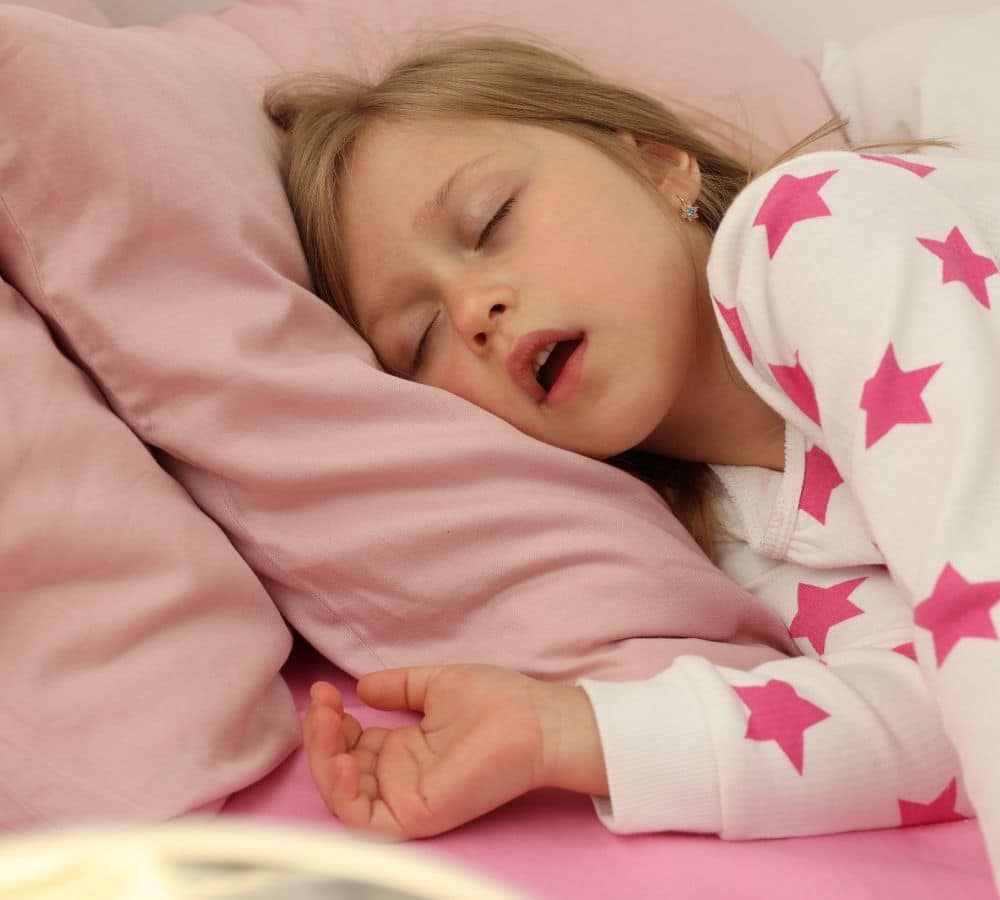
Mouth breathing during sleep is closely linked to snoring and obstructive sleep apnoea. When the mouth opens during sleep, the mandible drops downward and backward, narrowing the posterior airway. The tongue falls back toward the pharynx. Airway resistance decreases. The conditions for upper airway collapse are created.
The consequences:
Snoring: Vibration of relaxed oropharyngeal tissues in the turbulent airflow of mouth breathing. Snoring is not just a social nuisance. It indicates partial airway obstruction and disrupted sleep architecture.
Obstructive sleep apnoea: Repeated airway collapse during sleep, causing oxygen desaturation, cardiovascular stress, sleep fragmentation, and excessive daytime sleepiness.
Non-restorative sleep: Even without frank apnoea, mouth breathing during sleep is associated with poorer sleep quality, more frequent arousals, and reduced time in deep sleep stages.
Morning dry mouth and sore throat: The most immediately noticeable symptom, and often the one that finally brings patients to seek help.
4. Systemic Health Consequences
Beyond the oral and sleep effects, chronic mouth breathing has broader systemic implications:
Cardiovascular effects: Mouth breathing reduces nitric oxide delivery to the lungs, impairing vasodilation and potentially contributing to elevated blood pressure. The associated sleep disruption and sympathetic nervous system activation further stress the cardiovascular system.
Immune function: Bypassing the nasal filtration system increases exposure to airborne pathogens. Reduced nasal nitric oxide diminishes its antimicrobial effect. Mouth breathers, particularly children, have higher rates of upper respiratory infections, tonsillitis, and otitis media (middle ear infections).
Exercise performance: Nasal breathing during exercise has been shown to improve oxygen efficiency and reduce perceived exertion. Mouth breathing during exertion is associated with exercise-induced bronchoconstriction and reduced performance, particularly in athletes.
Cognitive and behavioural effects: In children, the sleep disruption caused by mouth breathing is associated with attention difficulties, behavioural problems, and academic underperformance. These symptoms overlap with ADHD, and some researchers have suggested that a proportion of children diagnosed with ADHD may actually have undiagnosed sleepdisordered breathing secondary to mouth breathing and airway obstruction.
Postural effects: Chronic mouth breathing is associated with a forward head posture and altered cervical spine alignment. The head tilts backward and the chin juts forward to open the oral airway, creating musculoskeletal strain in the neck, shoulders, and upper back.
How to Identify Mouth Breathing
Mouth breathing is often unrecognised because it is so habitual that the patient is unaware of it.
Key signs to watch for include:
In children:
- Lips habitually apart at rest
- Dry, cracked lips
- Visible upper teeth when the face is relaxed
- Dark circles under the eyes
- Narrow face with elongated lower third
- Snoring or restless sleep
- Frequent upper respiratory infections
- Difficulty concentrating at school
- Crowded or crooked teeth
- High-arched palate visible on examination
In adults:
- Waking with dry mouth or sore throat
- Chronic bad breath despite good oral hygiene
- Anterior gingival inflammation
- History of dental crowding or orthodontic treatment
- Snoring or diagnosed sleep apnoea
- Nasal congestion or history of allergies, deviated septum, or nasal polyps
- Forward head posture
The lip seal test: Close your lips and breathe through your nose for three minutes. If this feels uncomfortable, strained, or insufficient, you may be a habitual mouth breather.
What You Can Do About It
The management of mouth breathing depends on identifying and addressing the underlying cause while retraining the breathing pattern.
- Address nasal obstruction:
- Allergic rhinitis: antihistamines, nasal corticosteroid sprays, allergen avoidance
- Deviated septum: surgical correction (septoplasty) if conservative measures fail
- Nasal polyps: medical or surgical management
- Adenoidal hypertrophy (children): adenoidectomy when clinically indicated
- Turbinate hypertrophy: medical management or surgical reduction
- Myofunctional therapy:
- This is a structured exercise programme designed to retrain the muscles of the tongue, lips, and face to promote nasal breathing, correct tongue posture (resting against the palate), and establish lip seal. Myofunctional therapy is supported by a growing evidence base for both children and adults and can be delivered by trained dental hygienists, speech pathologists, or myofunctional therapists.
Key exercises include:
- Tongue posture training (tip of tongue on the “spot” behind the upper front teeth, body of tongue resting against the palate)
- Lip seal exercises
- Nasal breathing practice during daily activities and exercise
- Swallowing pattern correction
- Orthodontic intervention (children): Palatal expansion during the growth period can widen the upper jaw, increase nasal cavity volume, and create space for the tongue. This addresses both the dental crowding and the nasal obstruction caused by a narrow palate, breaking the mouth breathing cycle at its structural source.
- Environmental management:
- Humidification of bedroom air, particularly in winter
- Allergen reduction (dust mite covers, air purifiers, pet management)
- Elevation of the head during sleep
- Avoiding alcohol and sedatives before bed (these relax oropharyngeal muscles and promote mouth breathing)
- Dental management:
- Fluoride therapy and remineralising products to protect teeth exposed to chronic dry mouth
- More frequent professional cleaning and monitoring
- Salivary stimulants and moisturising products for symptomatic relief
- Orthodontic or restorative treatment to address the dental consequences of mouth breathing
How Smile Solutions Approaches Mouth Breathing
At Smile Solutions, mouth breathing is not a footnote. It is a clinical finding that triggers investigation and, where appropriate, intervention.
Our assessment includes:
- Evaluation of facial growth pattern and skeletal relationships
- Intraoral assessment of palatal width, tongue posture, and airway signs
- Screening for sleepdisordered breathing symptoms
- Referral for ENT assessment when nasal obstruction is suspected
- Orthodontic consultation for children with mouth breathing-related growth changes
- Myofunctional therapy recommendations
- TMD and sleep clinic assessment for adults with bruxism
- TMJ symptoms, and suspected OSA
With more than 80 clinicians including orthodontists, periodontists, and sleep dentistry specialists, we have the multidisciplinary expertise to address mouth breathing from every angle, from the structural causes to the dental consequences to the systemic health implications.
Breathe Better, Live Better
Mouth breathing may seem trivial, but its effects compound over a lifetime. In children, it shapes the face and airway in ways that can predispose to lifelong health problems. In adults, it accelerates dental disease, disrupts sleep, and contributes to systemic inflammation. And in everyone, it means the body is working harder than it needs to for every single breath.
The encouraging news is that mouth breathing is identifiable, its causes are treatable, and nasal breathing can be retrained at any age. It starts with awareness and a comprehensive assessment.
If you or your child shows signs of mouth breathing, or if you are experiencing unexplained dry mouth, dental problems, or poor sleep despite adequate time in bed, we encourage you to book an assessment.